


Scroll down to D0vvnl0ad
How Mobs Evolve in Minecraft PE/Bedrock Maps

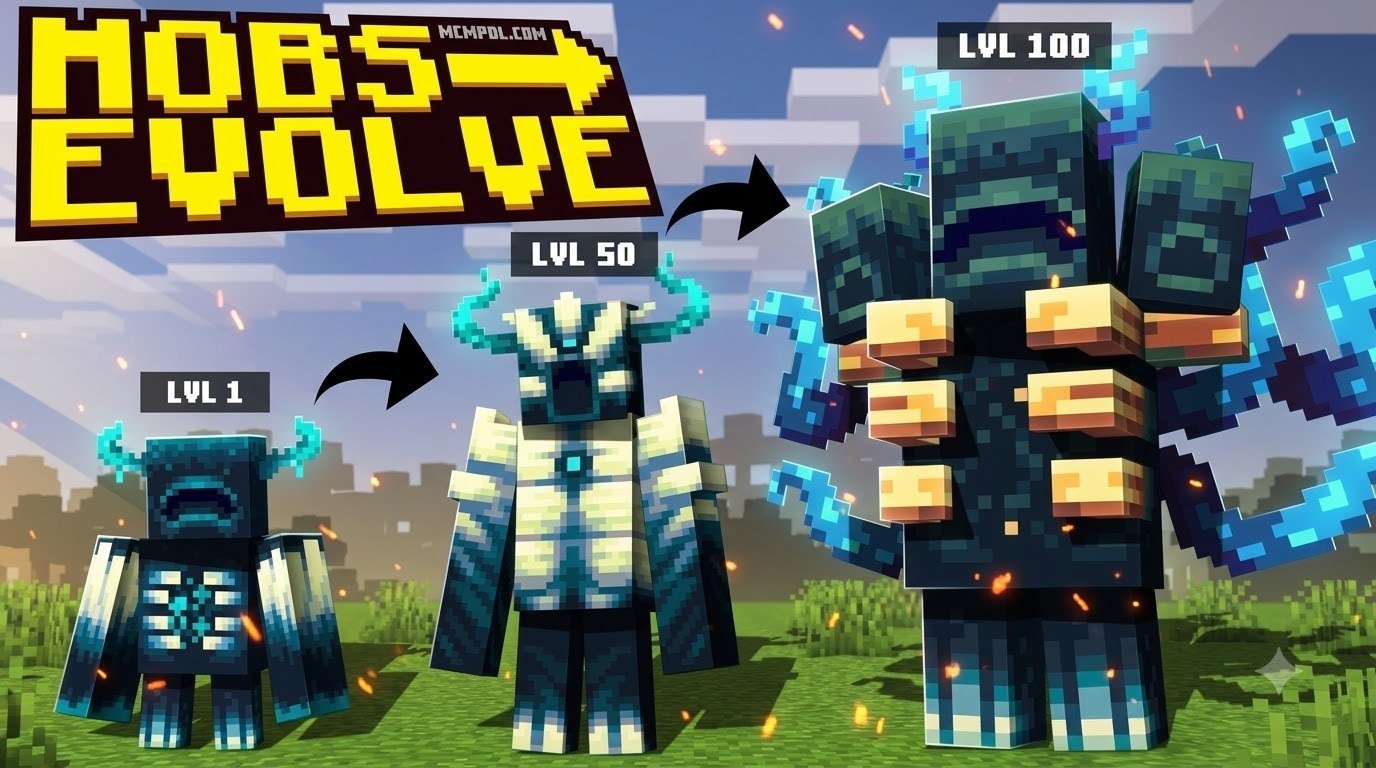
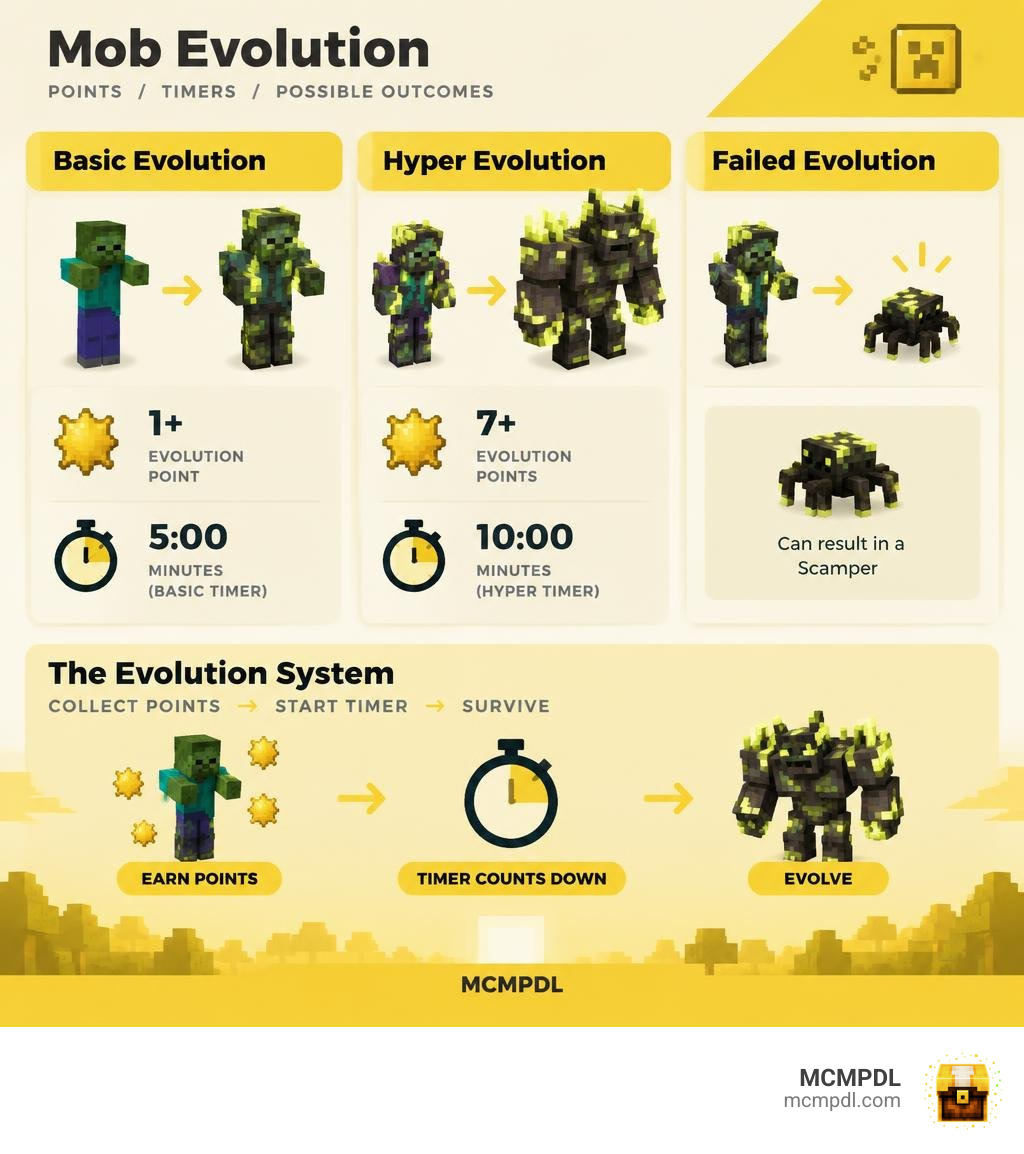
A Mobs Evolve Map for Minecraft PE/Bedrock lets you face infected mobs that can change into stronger forms. In the Fungal Infection: Spore evolution system, a mob needs at least one Evolution Point to start a five-minute basic evolution timer. An already evolved mob needs seven points to start a ten-minute hyper evolution timer. The mob must survive until its timer ends.
Not every change goes to plan: an evolution can fail and produce a Scamper instead. Before playing, check that the map and its required add-on support your Bedrock version. The guide below explains the forms, triggers, and controls to look for.
Core Mechanics of the Mobs Evolve Map for Minecraft PE/Bedrock
In our curated Bedrock survival maps, the evolution system transforms standard nighttime threats into dynamic, progressing horrors. Instead of fighting static monster variants indefinitely, mobs accumulate power as they roam, fight, and survive in your world. At the heart of this system are Evolution Points and Evolution Timers.

Every infected entity collects Evolution Points through combat interactions, survival time, or environmental catalysts. Once an entity acquires the necessary points, an Evolution Timer triggers automatically:
- Basic Evolution Threshold: Requires at least 1 Evolution Point and initiates a 5-minute countdown.
- Hyper Evolution Threshold: Requires an already evolved mob to collect at least 7 Evolution Points, initiating a 10-minute countdown.
For an evolution to complete successfully, the mob must remain alive until the timer reaches zero. If a player or hazard kills the creature during this countdown, the mutation chain is broken.
Environmental modifiers play a massive role in managing these timers. If an evolving mob is inflicted with the Frostbite status, its internal evolution timer completely freezes until the effect wears off. Conversely, when an entity comes into contact with Overcharged Scents, its active timer is cut in half, forcing players to adapt quickly. If you enjoy tense underground skirmishes with mutating threats, you can explore similar mechanics within the Mutant Caves Map for Minecraft PE/Bedrock or test your combat limits across worlds spawning diverse entities.
Basic and Hyper Progression in Mobs Evolve Map for Minecraft PE/Bedrock
When the 5-minute timer of a basic infected entity expires, the creature mutates into a specialized combatant. The resulting form depends directly on the base entity type:
- Infected Human: Has an even 22.5% chance to evolve into one of four distinct forms: the heavily armored Knight, the destructive Griefer, the brute Braiomil, or the agile Phayres.
- Infected Drowned: Has a 45% chance to mutate into either a Bloater (a resilient aquatic hazard) or a Naiad (a swift swimming predator).
- Infected Husk and Variants: Transform into environmental-specific horrors designed to overwhelm desert and arid biomes.
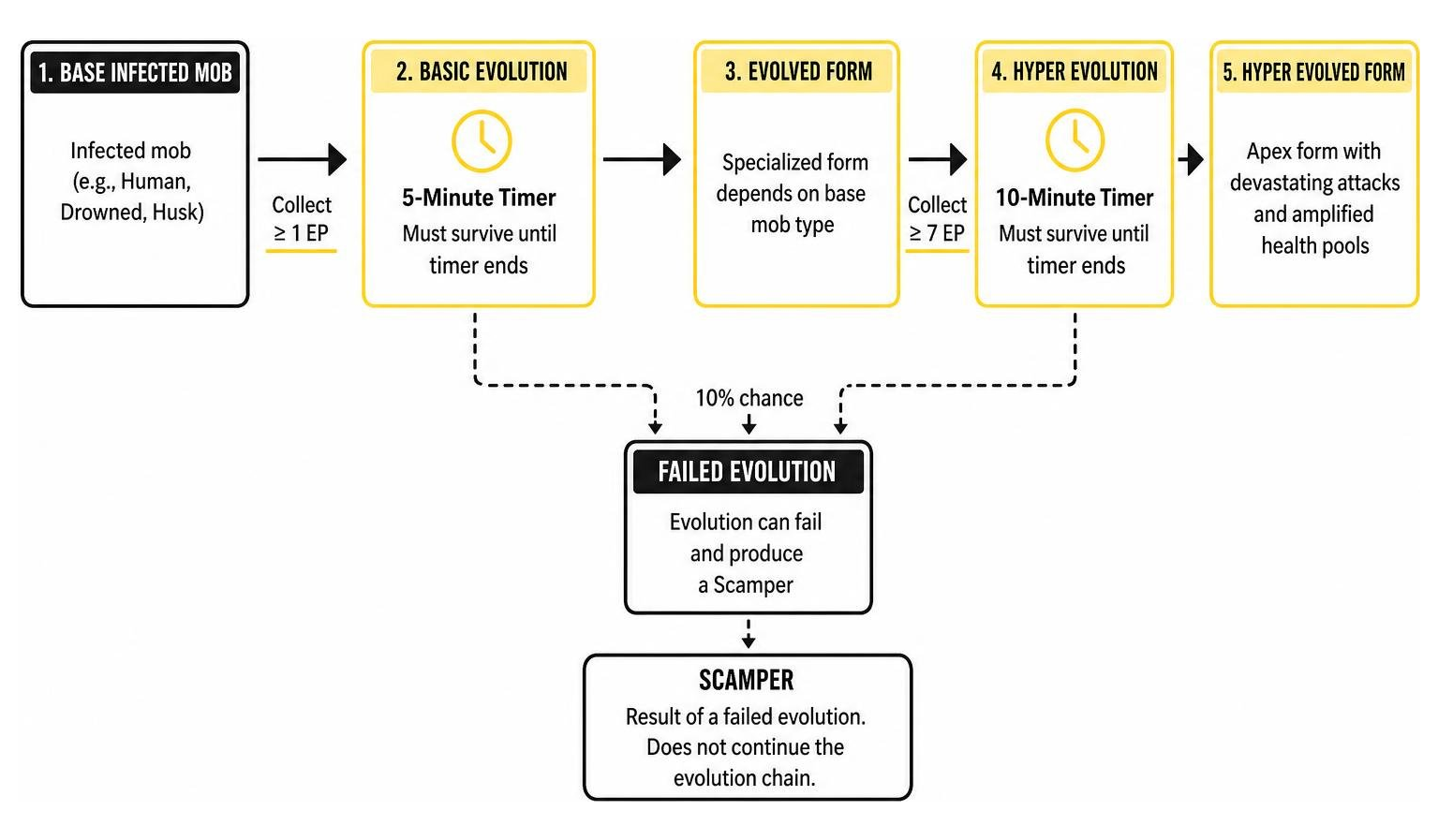
If any of these evolved forms survive long enough to gather 7 Evolution Points and outlast their 10-minute Hyper Evolution timer, they ascend into apex threats with devastating attacks and amplified health pools. You can review full mob rosters across comprehensive entity rosters and compare these systems with the documented mechanics outlined on Fungal Infection: Spore Wiki.
Failed Mutations and Linked Transformations
Mutations do not always produce predictable warriors. Whenever an Infected Human or allied entity attempts to evolve, there is a flat 10% chance that the process collapses into a Failed Evolution.
When evolution fails, the entity mutates into a Scamper—a fragile, erratic creature. While individual Scampers seem unthreatening, their true danger lies in hive synergy. A Scamper possesses an internal 10-minute age timer. If it remains “Linked” to an active hive network when this timer expires, it has a 30% chance to evolve into a massive Gastgeber or consolidate into biological Mounds.
This mechanism directly feeds into the Hivemind Progression cycle:
- Defeated entities and biological waste assemble around a Reconstructed Mind Block.
- Once the block accumulates 40 Kill Points, it awakens and transforms into a Proto Hivemind, broadcasting the eerie warning “Endure…” in chat.
- If a player destroys a Hivemind’s main physical anchor, it degrades into a dormant Hivetumor.
- The Hivetumor requires 1200 seconds (20 minutes) to regenerate fully back into a Proto Hivemind.
Additionally, specific creatures undergo Linked Evolution when tethered to high-tier hive structures. Under these specialized conditions, an Infected Diseased Villager can bypass standard branches to become a Reaper, Specter, or frontline Vanguard.
Instant Evolution Triggers and Manual Controls
While standard survival revolves around tracking 5-minute and 10-minute timers, map creators and players can trigger mutations instantly using environmental catalysts and creative tools.

Two key environmental modifiers bypass standard countdowns:
- Proto World Modifier: Grants a passive 30% chance for newly spawned infected mobs to trigger an Instant Evolution on spawn.
- Mutagenic Reactant: A potent chemical catalyst that provides a 10% instant mutation chance when applied directly to active infected entities.
For testing, custom arena creation, or survival map authoring, administrators can manipulate these systems directly. Players can craft or spawn Evolution Syringes to inject specimens with immediate evolutionary energy, or execute the command /spore:evolve while targeting any eligible infected entity to force an immediate mutation. These mechanics create unpredictable encounters in challenging survival worlds.
Evolution Systems Compared: Bedrock Spore vs Mope.io and Vanilla Mechanics
To understand how mob evolution alters Bedrock gameplay, it helps to compare point-driven progression against other gaming models and standard vanilla Minecraft mechanics.
In web-based evolution titles, players experience a rigid tier ladder. For instance, in the tiered progression in Mope.io, entities progress through 15 distinct animal tiers across forest, ocean, arctic, desert, and volcano biomes. Players accumulate score points to become apex creatures like a Dragon or Kraken at 1 Million XP, eventually reaching a fire-immune Black Dragon at 10 Million XP.
By contrast, standard Minecraft uses fixed classifications. The vanilla hostile monster classifications define static creatures required for advancements like Monster Hunter (defeating any hostile monster) and Monsters Hunted (defeating all 41 current hostile monsters, or 42 with upcoming additions like Frostbite). Vanilla monsters spawn with static attributes and do not change form based on survival time or kill counts.
| Feature | Fungal Infection: Spore (Bedrock) | Mope.io Progression System | Vanilla Minecraft Monsters |
|---|---|---|---|
| Progression Trigger | Survival timers + Evolution Points | Experience Points (XP) from food/kills | Static spawns (no evolution) |
| Branching Paths | Probabilistic (22.5% Human, 45% Drowned) | Linear tier selection per biome | Fixed entity identity |
| Failure State | 10% chance to become a Scamper | Downgrade / death by predators | None |
| Apex Entity | Hyper Evolved / Proto Hivemind | Black Dragon (10M XP tier) | Warden / Ender Dragon |
| Behavior Modifiers | Frostbite freeze, Overcharged Scents | Water drain, temperature meters | Regional difficulty / armor spawns |
These dynamic branching mechanics offer depth comparable to custom entity packs like Mowzie’s Mobs Addon for Minecraft PE/Bedrock, turning everyday perimeter defense into a race against the clock.
Map Strategies and Entity Management
Surviving in a world where mobs evolve requires planning beyond standard vanilla base-building. Because infected mobs become deadlier the longer they stay alive, passive perimeter designs often fail over time.
Survival Tactics for Mobs Evolve Map for Minecraft PE/Bedrock
- Prioritize High-Threat Targets: Always eliminate entities that have accumulated combat kills before their 5-minute timer completes. Preventing an Infected Human from rolling into a Griefer or Braiomil saves your base structures.
- Leverage Frostbite Mechanics: Utilize freezing environmental traps or powder snow barriers around your outer wall. Inflicting Frostbite completely freezes active evolution timers, buying valuable time for defense.
- Eliminate Overcharged Scents: Clear out scent emitters near your perimeter immediately, as these halve evolution timers and trigger rapid hyper mutations.
- Disrupt Hivemind Formation: If you spot an emerging Reconstructed Mind Block, destroy surrounding infected mobs immediately to prevent it from reaching the 40 Kill Points required to birth a Proto Hivemind.
Entity Verification and Resource Planning
When designing custom maps or managing hardware performance on mobile Bedrock devices, track active entity counts carefully. Rapid Scamper duplication and hive node expansion can strain lower-end devices if left unchecked. You can cross-reference entity IDs and block registries using standard Bedrock item and mob catalogs to ensure clean command integration and balanced mob spawning limits.
Frequently Asked Questions About Mob Evolution
How do Evolution Timers and Evolution Points work?
An infected entity must earn at least 1 Evolution Point to start a 5-minute Basic Evolution timer. Hyper Evolution requires an already mutated mob to gather 7 points and survive a 10-minute timer. The mob must remain alive for the full duration to transform. The timer can be paused by Frostbite or halved by Overcharged Scents.
What triggers Failed Evolution into Scampers and Gastgebers?
Every basic evolution attempt carries an automatic 10% failure chance. When an evolution fails, the mob transforms into a Scamper. If that Scamper survives its own 10-minute age timer while linked to an active hive network, it has a 30% chance to mutate into a massive Gastgeber.
How can players manually force mob evolution in Bedrock?
Players can bypass countdown timers entirely by using an Evolution Syringe on an eligible infected mob or by executing the /spore:evolve command while targeting the entity. Environmental factors like the Proto World Modifier (30% chance) and Mutagenic Reactants (10% chance) can also trigger instant mutations.
Conclusion
Understanding mob mutation dynamics changes how you approach survival in Minecraft Bedrock. By mastering point thresholds, managing environmental status effects, and keeping hive nodes under control, you can build impenetrable bases and outlast the toughest evolved hordes.
Explore our extensive collection of curated adventure and survival worlds in the Minecraft PE Maps section on MCMPDL, and test your defensive strategies today!



1 thought on “Mobs Evolve Map for Minecraft PE/Bedrock”